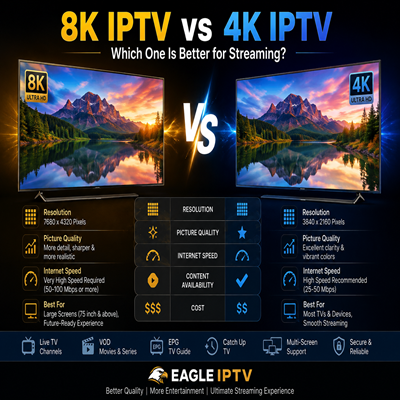
8K IPTV vs 4K IPTV: Which One Is Better for Streaming?
Streaming technology has changed the way we watch television. With better internet connections, modern Smart TVs, and advanced streaming devices, viewers can now enjoy much higher picture quality than traditional HD television.
Two of the most talked-about options are 4K IPTV and 8K IPTV. Both offer impressive picture quality, but 8K takes resolution to another level.
So, is 8K IPTV better than 4K IPTV, or is 4K still the more practical choice for everyday streaming?
In this guide, we will compare 8K IPTV and 4K IPTV, explain the major differences, and help you understand which option may be right for your setup.
What Is 4K IPTV?
4K IPTV refers to IPTV content delivered in 4K resolution. A typical 4K display has a resolution of approximately 3840 × 2160 pixels, giving you significantly more detail than standard Full HD.
For many viewers, 4K IPTV provides an excellent balance between picture quality and streaming performance.
With a compatible TV, suitable internet connection, and high-quality IPTV stream, 4K can produce sharp images with detailed textures and better overall clarity.
4K is particularly useful for:
- Sports streaming
- Movies
- Live television
- Documentaries
- Nature programs
- Large-screen TVs
- High-quality entertainment
For many households, 4K IPTV streaming is already more than enough for an enjoyable viewing experience.
What Is 8K IPTV?
8K IPTV takes picture resolution even further.
An 8K display typically provides a resolution of 7680 × 4320 pixels. That means it contains approximately four times as many pixels as 4K and sixteen times as many pixels as Full HD.
The additional pixels can produce extremely detailed images, especially when viewed on a large compatible screen.
However, there is an important point to understand: having an 8K television does not automatically mean that every IPTV channel will be available in native 8K.
The actual quality depends on the content source, stream, device, internet connection, and provider.
8K IPTV vs 4K IPTV: Main Difference
The biggest difference between 8K IPTV and 4K IPTV is resolution.
| Feature | 4K IPTV | 8K IPTV |
|---|---|---|
| Typical Resolution | 3840 × 2160 | 7680 × 4320 |
| Detail | Excellent | Extremely detailed |
| Bandwidth Requirement | High | Very high |
| Compatible TVs | 4K TVs and above | 8K TVs recommended |
| Content Availability | More widely available | More limited |
| Best For | Everyday high-quality streaming | Large-screen premium viewing |
| Technology | Mature | Emerging |
The higher resolution of 8K can provide a noticeable advantage on very large screens and at closer viewing distances. However, the difference may be difficult to notice on smaller TVs.
Is 8K IPTV Better Than 4K IPTV?
Technically, 8K IPTV can provide better image detail than 4K IPTV when the content is genuinely available in native 8K and the rest of the setup can handle it.
But “better” does not always mean “better for everyone.”
If you have a large 8K television, fast internet, compatible hardware, and access to high-quality 8K content, an 8K IPTV setup can offer an impressive viewing experience.
On the other hand, if your TV is 4K, your internet connection is limited, or most of the content you watch is available only in HD or 4K, upgrading to 8K may not provide a major practical benefit.
8K IPTV Requires More Bandwidth
One of the most important considerations when moving from 4K to 8K streaming is bandwidth.
Higher-resolution video generally requires more data to deliver a high-quality stream. This means your internet connection needs to be capable of handling demanding 8K streaming.
A fast connection alone, however, is not the only factor.
Your experience can also depend on:
- Network stability
- Wi-Fi quality
- Router performance
- Streaming device
- Video compression
- Server performance
- Stream bitrate
- Number of devices using the network
For the best 8K IPTV streaming experience, a stable high-speed internet connection is essential.
Does 8K IPTV Look Better on Every TV?
Not necessarily.
The benefits of 8K become more noticeable as screen size increases. On a very large television, the extra resolution can help produce a more detailed and refined image.
On a smaller screen viewed from a normal distance, the difference between 4K and 8K can be much harder to see.
This is why buying an 8K TV simply because it has a higher resolution may not automatically improve your overall streaming experience.
Your viewing distance and screen size matter.
8K IPTV Content Availability
Another major factor is content availability.
4K content has become much more common across modern streaming platforms and television services. Native 8K content, however, remains much less common.
This means you should not assume that subscribing to an IPTV service advertised with 8K support means every channel, movie, or live event will actually stream in native 8K.
Before choosing an 8K IPTV service, check what content is genuinely available in 8K and what is provided in lower resolutions.
This is especially important for viewers interested in sports, live events, movies, and premium entertainment.
8K IPTV for Sports Streaming
Sports are one area where higher resolution can be particularly appealing.
Large stadiums, players, grass textures, crowd details, and fast-moving action can benefit from a higher-quality source.
For viewers with a large 8K television, 8K IPTV sports streaming could eventually provide a highly immersive experience as more native 8K sports content becomes available.
However, the quality still depends on the original broadcast. If the source is only 4K or HD, an 8K television cannot magically turn it into genuine native 8K content.
Upscaling can improve how lower-resolution content appears, but it is not the same as receiving a native 8K source.
8K IPTV for Movies and Entertainment
Movies can also benefit from higher resolution.
On a large screen, additional detail can make landscapes, special effects, textures, and cinematic scenes look more impressive.
However, the difference between 4K IPTV and 8K IPTV will depend heavily on the original content.
A high-quality 4K movie can already look excellent, particularly on a good television with proper HDR support.
For many viewers, upgrading from Full HD to 4K will produce a much more noticeable improvement than moving from 4K to 8K.
4K IPTV Is Still a Great Choice
While 8K IPTV represents the future of ultra-high-resolution entertainment, 4K IPTV remains a very strong option for most people.
There are several reasons for this.
First, 4K content is more widely available. Second, 4K requires less bandwidth than comparable 8K streaming. Third, 4K televisions and streaming devices are generally easier to find.
For viewers who want excellent image quality without pushing their internet connection or hardware to the limit, 4K IPTV streaming can offer a practical balance.
Who Should Consider 8K IPTV?
8K IPTV may make more sense if you:
- Own a large 8K television
- Have a fast and stable internet connection
- Want the highest available resolution
- Enjoy premium movie and sports content
- Sit relatively close to a large screen
- Have compatible streaming hardware
- Want to explore the latest TV technology
If these points describe your setup, exploring 8K IPTV may be worthwhile.
Who Should Choose 4K IPTV?
4K IPTV may be the better choice if you:
- Own a 4K television
- Mainly watch movies and live TV
- Want excellent picture quality
- Have a good but not extremely fast internet connection
- Want wider access to 4K content
- Prefer a more practical streaming setup
For many households, 4K provides the right combination of quality, compatibility, and availability.
How to Get the Best 8K IPTV Experience
If you decide to explore 8K IPTV, your internet connection is only one part of the equation.
For a smoother experience, consider the complete setup.
1. Use a Compatible 8K TV
An 8K television is recommended if you want to experience native 8K content properly.
2. Use a Suitable Streaming Device
Make sure your IPTV application and streaming device support the resolution and video formats you intend to use.
3. Prefer a Wired Connection When Possible
Ethernet can provide a more consistent connection than unreliable Wi-Fi, particularly when streaming high-bandwidth video.
4. Check the Actual Stream Quality
Do not rely only on labels such as “8K.” Check whether the content is genuinely available in the advertised resolution.
5. Test Your Network
Before blaming an IPTV stream for buffering, check your own network. Other devices downloading large files or streaming video simultaneously can affect performance.
What About 8K Upscaling?
Many modern 8K televisions include upscaling technology.
Upscaling takes lower-resolution content and processes it to fit an 8K display.
For example, 4K content can be displayed on an 8K television using the TV’s processing technology.
This can make the image appear sharper in some situations, but it is important to understand the difference between upscaled 8K and native 8K.
Native 8K content originates from an 8K source, while upscaled content starts at a lower resolution.
Is 8K IPTV Worth It in 2026?
For the right viewer, 8K IPTV can be exciting. But for most people, the decision should depend on their television, internet connection, content preferences, and available 8K programming.
If you already own an 8K TV and enjoy experimenting with the latest entertainment technology, exploring 8K content makes sense.
If you are currently using a Full HD television, moving to 4K may be the more noticeable upgrade.
And if you already have a good 4K setup, there may be less urgency to upgrade unless you specifically want the benefits of a large 8K display.
Final Verdict: 8K IPTV vs 4K IPTV
So, which is better: 8K IPTV or 4K IPTV?
The answer depends on your setup.
8K IPTV wins on maximum resolution and potential image detail, particularly on large screens with genuine native 8K content.
4K IPTV wins on practicality, content availability, compatibility, and bandwidth requirements.
For everyday streaming, 4K remains an excellent choice. For viewers who want to explore the next generation of ultra-high-definition entertainment, 8K IPTV offers an exciting step forward.
The most important thing is not simply choosing the highest number. Choose a streaming setup that matches your TV, internet connection, viewing habits, and the content you actually want to watch.
As 8K technology continues to develop, the availability of high-quality 8K content is likely to become increasingly important for viewers looking for the ultimate IPTV experience.
Why Eagle IPTV?
When exploring an IPTV service, look beyond channel numbers and focus on the overall viewing experience. Picture quality, streaming stability, device compatibility, available content, and customer support all matter.
If you are considering Eagle IPTV, check the currently available plans, supported devices, streaming quality, and content options before choosing the subscription that best fits your needs.
8K is about more than resolution — it is about bringing a more detailed and immersive viewing experience to the biggest screens.
Leave a Reply